




Cases of polio – which can cause paralysis, breathing difficulties and death – have decreased sharply thanks to vaccination. However, the disease continues to occur in two countries, Afghanistan and Pakistan, threatening a worldwide push to end polio.

Can the virus be eradicated? And how will we know when it’s gone?
We put these questions to Professor David Salisbury, Chair of the Global Commission for the Certification (GCC) of Poliomyelitis Eradication. Prof Salisbury is a member of the Vaccines Today Editorial Board, which is a voluntary role.
Vaccines Today: Can polio be eradicated?
Prof Salisbury: Yes – polio can undoubtedly be eradicated. There are three types of polioviruses called Type 1, 2 and 3. We certified that Type 2 viruses had been eradicated in 2015 and type 3 viruses in 2019.
Since those dates, these viruses have not been detected anywhere in the world, meaning that we got the Certification of Eradication right. Only Type 1 poliovirus remains, at the moment in Pakistan and Afghanistan.
What does the GCC actually do?
The GCC has six members and each of us represents a WHO Region: Europe*, Western Pacific, South East Asia, Region of the Americas, Eastern Mediterranean, Africa).
Our jobs are, first, to review the progress towards the disappearance of polioviruses so that once we are convinced that polioviruses have indeed gone, we can certify their eradication. Our other job is to monitor the safeguards that are being put in place for the secure containment of any polioviruses.
After eradication, the only places that should be holding polioviruses will be manufacturers that need them to make vaccines, and laboratories that undertake essential research. Therefore, we need a Containment Scheme that audits any places holding polioviruses to ensure that they cannot escape.
*Prof Salisbury represents the WHO European Region.
Why is it proving so difficult to end polio?
The commitment to polio eradication started in 1988 and progress has indeed been slow. But we have shown that two types of polioviruses can be eradicated even in the most difficult of circumstances.
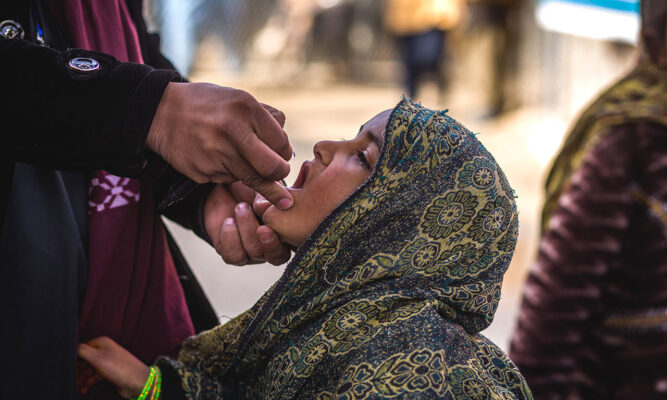
However, it has proved extremely difficult to get immunisation up to the needed levels in Pakistan and Afghanistan. There are many reasons ranging from poor implementation of routine vaccination services for children and not good enough implementation of polio vaccination campaigns.
Additionally, especially in Pakistan, insecurity poses considerable risks and health workers have lost their lives just for trying to vaccinate children. In South Afghanistan, the local Taliban is resistant to female health workers who ideally should be going into people’s houses to find and vaccinate young children.
If there is only Type 1 polio in Afghanistan and Pakistan, why should we worry?
The saying is that ‘polio anywhere, threatens us everywhere’. Polioviruses travel when people travel and there have been numerous examples of polioviruses from one part of the world turning up somewhere else. It is for this reason that we must maintain high coverage of polio vaccination, everywhere, even in countries that have not seen polio for decades.
If vaccination coverage falls, for whatever reason, there will be susceptible children who will be at risk of paralysis should they come into contact with the virus.
If there are no Type 2 and 3 cases reported, how can you be sure that polio has indeed gone?
The quality of our surveillance has actually improved progressively over recent years. Originally, our surveillance for polio depended on finding cases of children with paralysis that looked like polio, and then being able to confirm that they were not caused by polio.
Now, we also have environmental surveillance where sewage is tested regularly in a hunt for polioviruses. We regularly find polioviruses in sewage that have got there from polioviruses from oral vaccines. And we find poliovirus type 1 especially in Pakistan and Afghanistan. But we do not find poliovirus types 2 and 3. So, we can be sure those types of polioviruses have been eradicated.
When Type 1 viruses can no longer be found in paralysed children and in the environment, we will be able to certify Type 1 eradication.
Learn more and see how you can help: Take Action | End Polio