




Cases of whooping cough (pertussis) have surged across Europe, with England recording a 1,600% increase in 2024 alone, according to a review of the evidence from the International Longevity Centre UK (ILC).
The ILC’s report, From the 100-day cough to the 100-year life: pertussis, prevention and the future of life course immunisation, warns that the rise in infections is being driven in part by missed diagnoses, low public and professional awareness, and weak vaccination systems beyond childhood.
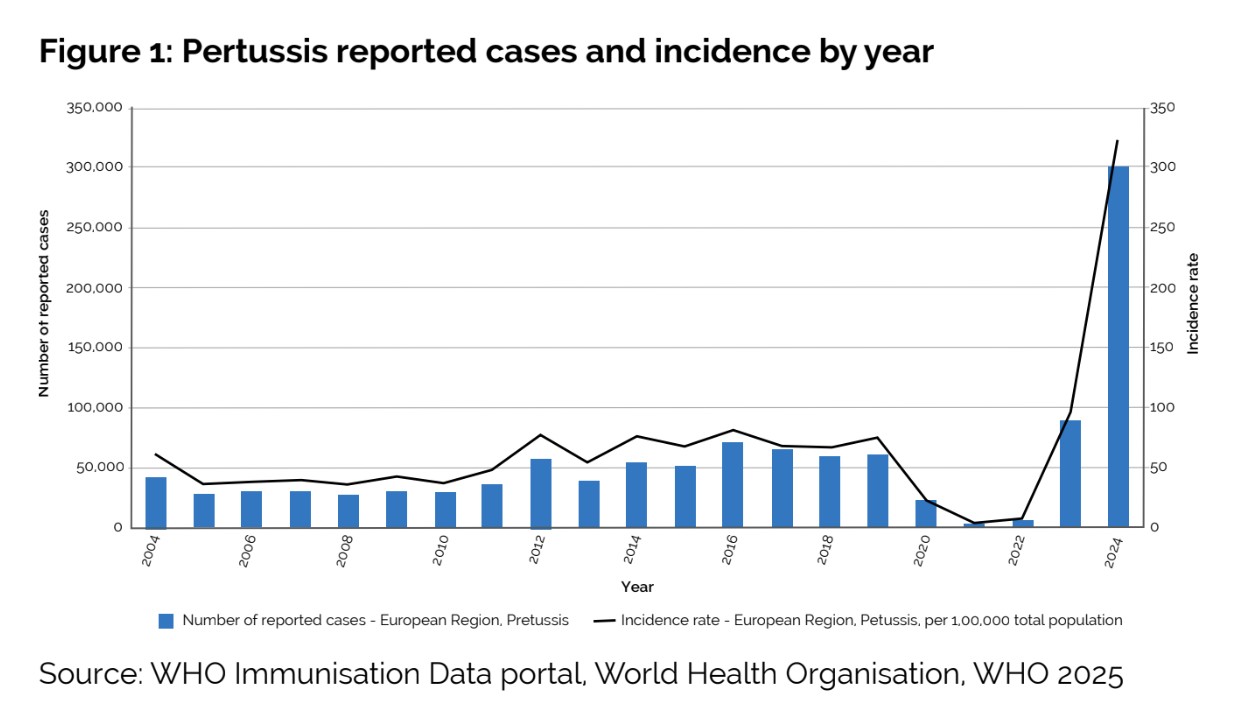
While pertussis is widely seen as a childhood disease, the data show that most confirmed cases are now in older age groups. In England, nearly six in ten cases occur among people aged 15 and over.
Experts say symptoms in adults are often mistaken for other respiratory illnesses, allowing infections to spread undetected. This creates a particular risk for infants, who are more vulnerable to severe illness and death. Pertussis also causes significant quality-of-life issues, often for months, in older people.
The case for life-course vaccination
The failure of health systems to take a life-course approach to immunisation, becomes more serious as populations age and immunity wanes over time. The ILC-UK is calling for stronger surveillance systems, better training for healthcare professionals and clearer public messaging to improve vaccine uptake.
It also recommends introducing national targets for adult vaccination, alongside reminder systems to encourage booster uptake.
‘Easily preventable diseases like pertussis are on the rise because we’re not serious about vaccination programmes across the life course,’ said Arunima Himawan, ILC’s Senior Health Policy and Research Manager.
European health experts interviewed as part of the research argue that without action, rising infection rates risk undermining both public health and economic resilience – particularly in ageing societies. The report highlights the economic case for action. Every €1 invested in adult immunisation can deliver up to €19 in return. Strengthening life-course immunisation programmes is essential not just to reduce disease, but to support healthier, longer lives, ILC argues.
‘Every year, respiratory infections hospitalise hundreds of thousands of people across Europe and cause tens of thousands of deaths,’ says Arunima Himawan from ILC. ‘They also impact on our longer-term health – increasing the risk of heart attacks, stroke, cognitive decline and disability. If we’re serious about prevention, we need to treat adult immunisation as part of health and economic security – not an afterthought.’
Background
The WHO European Region has reported a threefold increase in pertussis cases. In England, cases rose by 1,600% in 2024 compared with the previous year (there were 14,905 cases reported in 2024 compared with 856 in 2023), exceeding levels seen during the 2012 outbreak. Between 2018-2024, 58.8% of confirmed cases were found in those aged 15+.
In 2024, analysis from the Office of Health Economics showed that investing in adult vaccination programmes delivers substantial economic and societal benefits, with returns of up to 19 times the initial investment.
The ILC interviewed 28 experts from ten countries: Australia, Austria, Belgium, France, Germany, Hungary, Italy, Spain, Switzerland and the UK to better understand how to reduce high rates of infections and increase vaccine coverage.
Barriers & solutions
- Poor diagnosis
Symptoms in older people are often missed or misdiagnosed, allowing outbreaks to spread and affecting quality of life.
Action: Strengthen real-time surveillance systems, with better national, regional and local reporting. - Uneven healthcare professional awareness and low prioritisation
Limited awareness and understanding of adult vaccination reduces detection, treatment and vaccine uptake.
Actions: Improve training and guidance for healthcare professionals, particularly those working with at-risk groups; Integrate pertussis into multi-pathogen PCR testing for respiratory infections to reduce costs and increase coverage - Poor awareness among the adult population
The belief that pertussis is only a childhood disease continues to limit adult vaccination uptake.
Action: Introduce call and recall systems, supported by clear public information on risks and benefits of vaccination across the life course. - Lack of national recommendations
Guidance on adult vaccination varies significantly across countries, with some lacking clear recommendations altogether.
Actions: Establish clear national targets for adult pertussis vaccination, including boosters; Work towards a shared European ambition to increase adult vaccination coverage.
Read the report: From the 100-day cough to the 100-year life: pertussis, prevention and the future of life course immunisation.